We’ve all been there: you check the weather, and it says “0% chance of rain,” only to get caught in a downpour an hour later. Weather is one of the most complex and chaotic systems on Earth, and predicting it has always been incredibly difficult.
Google DeepMind, Google’s artificial intelligence research lab, has just announced a major upgrade to its weather-predicting AI, called WeatherNext 2. In simple terms, this is a new, smarter “brain” for forecasting, and it’s designed to make the weather predictions you see every day much more reliable, detailed, and faster.
This isn’t just a small update; it’s a new approach that’s already being built into the Google products you use, like Google Search, Google Maps, and Gemini.
The Old Way: Why Is Weather So Hard to Predict?
Traditionally, weather forecasts are made by massive supercomputers. These machines run complex “physics-based models,” which are basically giant sets of equations that try to calculate how the atmosphere (the air, heat, and moisture) will move and change over time.
This method has two big drawbacks:
- It’s Slow: Running these calculations takes a lot of time and computing power, sometimes hours.
- It Gives One “Best Guess”: Most of the time, these models give you just one likely outcome. The problem is, a tiny, unnoticeable change in the starting conditions (like a slight shift in wind) can lead to a completely different result (like a storm forming, or not).
The New Way: How WeatherNext 2 Changes the Game
WeatherNext 2, developed with Google Research, uses AI to tackle these problems in a new way.
1. It’s Incredibly Fast Instead of taking hours, WeatherNext 2 can generate a forecast in under a minute. It’s about 8 times faster than Google’s previous AI weather model. This speed means it can provide more frequent and up-to-date forecasts.

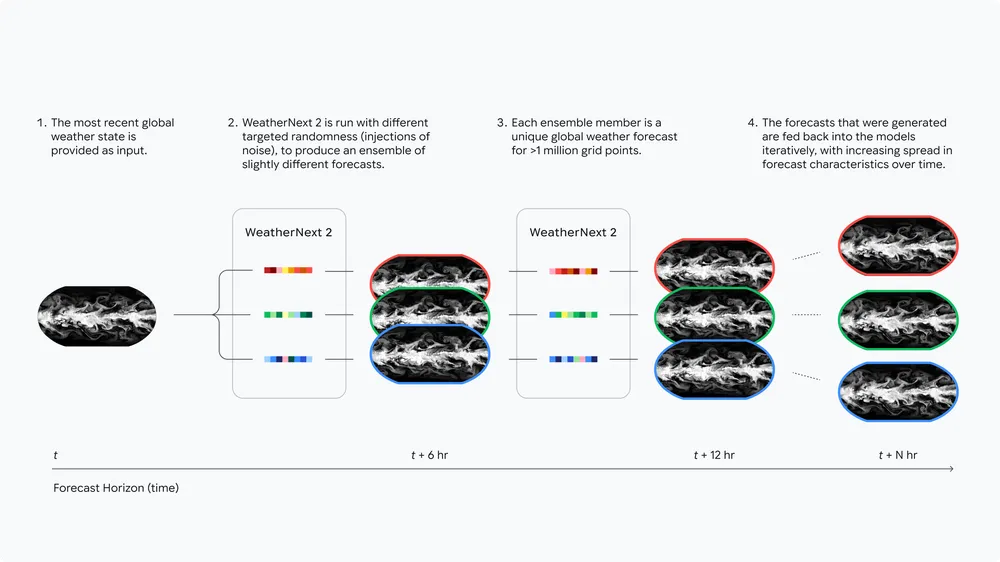
2. It Doesn’t Give One Answer It Gives Hundreds This is the most important change. Instead of just one “best guess,” WeatherNext 2 gives a “full range of possible forecasts” all at once.
Think of it this way:
- Old Model: You ask, “Will it rain at 3 PM?” It answers, “No.”
- WeatherNext 2: You ask the same question. It answers, “There is a 70% chance of no rain, a 20% chance of a light drizzle, and a 10% chance of a sudden, heavy downpour.”
This is called an “ensemble forecast,” and it’s a huge deal. It allows forecasters (and you) to see not just what is most likely to happen, but also what could happen. This is especially critical for predicting rare but dangerous events like cyclones or flash floods. The AI can explore hundreds of possibilities, capturing the true uncertainty of the weather.
3. It Predicts Everything at Once The technology in WeatherNext 2 is smart enough to understand how different weather conditions are connected. The team at Google DeepMind highlights two types of predictions it excels at:
- Marginals: A simple prediction for one specific thing. For example, “What will the temperature be at this exact location?”
- Joints: A more complex prediction that combines multiple things. For example, “What will the expected wind speed and direction be over this entire 10-square-mile area with wind turbines?”
This “joint” prediction is vital for industries. An energy company doesn’t just need to know if it will be “windy”; it needs to know the exact speed and direction to calculate how much power its wind turbines will generate.
Where Will You See WeatherNext 2?
This new technology isn’t just staying in a research lab. Google is already using it to improve the weather information you see every day. You’ll find forecasts powered by WeatherNext 2 in:
- Google Search: When you type “weather” or “weather near me.”
- Gemini: If you ask the AI assistant for a forecast.
- Pixel Weather: On the “At a Glance” widget on Google’s Pixel phones.
- Google Maps: Soon, it will also help power the weather information you see when planning a route.
This means the forecasts on your phone are getting a serious upgrade, backed by a faster, more thorough, and more accurate AI. It’s a big step toward taking the “guesswork” out of the weather.
Source: Google