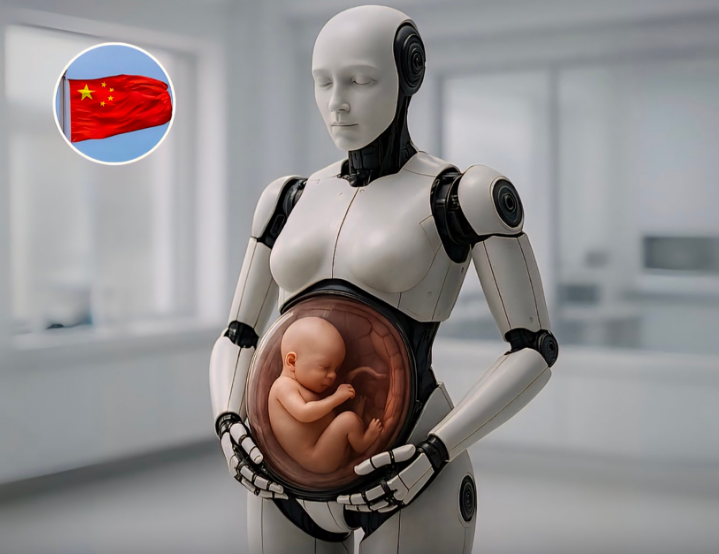
Imagine a world where a robot could carry a baby for nine months and then give birth. It sounds like a scene straight out of a science fiction movie, but a team of scientists in China is working to make this a reality. They are developing what they call a “pregnancy robot” a life-like robot with an artificial womb inside, designed to carry and deliver a human baby.
This groundbreaking technology could change everything we know about childbirth. Let’s break down what this is, how it works, and why it’s being created.
What Exactly Is a ‘Pregnancy Robot’?
At its core, the project involves two main pieces of technology combined into one:
- A Humanoid Robot: This is the machine’s outer shell, which looks like a person. Its main job is to house and protect the second, more important piece of technology.
- An Artificial Womb: This is the real star of the show. It’s a high-tech “gestation chamber” or synthetic uterus built inside the robot’s abdomen. The goal is for this artificial womb to do everything a human uterus does: safely nurture a growing fetus for a full term, which is about 10 months.
A team led by Dr. Zhang Qifeng at a company called Kaiwa Technology in Guangzhou, China, is spearheading this ambitious project. They believe the technology for the artificial womb is already at a “mature stage” and their main task now is to successfully integrate it into the humanoid robot.
How Would a Robot Womb Actually Work?
You might be wondering how a machine could possibly provide what a baby needs to grow. The concept is based on recreating the biological process of pregnancy artificially.
Think of it like a high-tech life-support system for a fetus. A tube, acting like a robotic umbilical cord, would connect to the artificial womb. This tube would constantly deliver all the essential nutrients, oxygen, and everything else a fetus needs to develop and grow, just as it would receive from its mother.
This isn’t an entirely new idea. In 2017, researchers in Philadelphia successfully kept premature lambs alive for weeks inside a “biobag” a fluid-filled, temperature-controlled bag that functioned like an external womb. The Chinese project aims to take this concept to the next level by creating a system that can support a human fetus from embryo to full-term baby.
If all goes to plan, Kaiwa Technology hopes to reveal a working prototype as early as 2026.
But Why Create a Pregnancy Robot?
This invention isn’t about replacing mothers or the natural experience of pregnancy. Instead, it’s being developed as a new option for people who face significant challenges in starting a family.
A New Hope for Families
For millions of couples worldwide, having a child can be a difficult journey. This technology could be a lifeline for:
- Individuals or couples struggling with infertility.
- Women who cannot carry a pregnancy to term due to health risks.
- Same-sex couples who want to have a biological child.
The Cost Factor
Currently, one of the main alternatives for these families is surrogacy, where another woman carries the baby for them. However, surrogacy can be incredibly expensive. In the United States, it can cost anywhere from $100,000 to $200,000.
The creators of the pregnancy robot estimate its price will be around 100,000 yuan, which is about $14,000 USD. This drastically lower cost could make it a much more accessible option for families around the globe. As one commenter noted, “This isn’t for people who can and want to have pregnancy. It’s an optional choice.”
Navigating the Big Ethical Questions
Naturally, a technology this revolutionary brings up a lot of important questions and concerns. People are rightfully wondering about the ethics of growing a baby inside a machine, the potential psychological effects on the child, and the very definition of parenthood.
The developers are aware of these complex issues. Dr. Zhang has stated that his team is actively discussing the ethical and legal implications with government authorities. They are holding forums and proposing new policies to ensure the technology is used responsibly if and when it becomes available.
The Dawn of a New Era in Childbirth?
For now, the pregnancy robot is still in development. But if a successful prototype is launched in 2026, it could spark one of the most significant and disruptive debates in the history of reproductive technology.
This isn’t just about a new machine; it’s about a technology that could fundamentally change how we create families. It offers potential solutions to deep-seated problems like infertility but also forces us to confront profound questions about life, nature, and the role of technology in our most human experiences. The world will be watching closely to see what happens next.