Google just announced a major new project that could change how we buy things online, and it involves three big topics: Artificial Intelligence (AI), Payments, and even Cryptocurrency.
The project is called the “Agent Payments Protocol,” or AP2 for short.
In simple terms, Google is leading a team of over 60 massive companies to create a “common language” that lets AI programs (or “agents”) securely pay for things on their own.
Let’s break down what that actually means.
What is an “AI Agent” and What’s the Problem?
Right now, you probably use AI as an assistant.
- You can ask Google Assistant, “What’s the weather?”
- You can ask a travel chatbot, “Find me the cheapest flights to London.”
The AI is great at finding information. But when it’s time to act to actually buy that flight ticket it hits a wall. The AI shows you a link, and you have to pull out your credit card, type in all 16 digits, the expiration date, and the CVC code.
An AI “Agent” is the next step. It’s an AI you don’t just ask for info, you give it a job to do. For example:
- “Hey AI, please book me the cheapest non-stop flight to London for next Tuesday.”
- “Hey AI, my groceries are running low. Please re-order milk, eggs, and bread from my usual store.”
For the AI to do this, it needs a way to pay. But you can’t just give your credit card details to a chatbot. That’s not secure. There’s no standard way for an AI to prove it’s allowed to spend your money.
This is the problem Google’s AP2 wants to solve.
How Does This New “Protocol” Work?
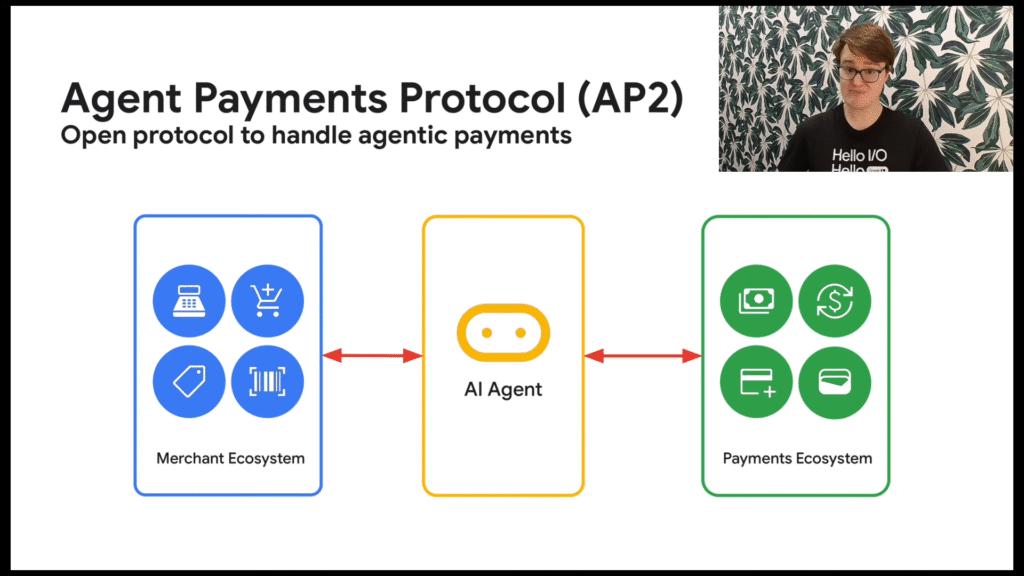
Think of a “protocol” as a shared rulebook. Just like SMTP is the rulebook all email services (like Gmail and Outlook) agree to use so they can send emails to each other, AP2 is a rulebook for payments that AI agents can use.
Google didn’t create this alone. They brought in everyone that matters in payments:
- Traditional Finance: Mastercard, PayPal, American Express, Adyen.
- Crypto & Web3: Coinbase, Ethereum Foundation, MetaMask.
- Big Tech & Commerce: Adobe, Salesforce, Shopify, Etsy.
By getting everyone to agree on one rulebook, they ensure that an AI agent can securely talk to any bank, credit card, or crypto wallet.
This system is built on “mandates,” which is just a fancy word for “permissions” that you, the human, set. There are two main types:
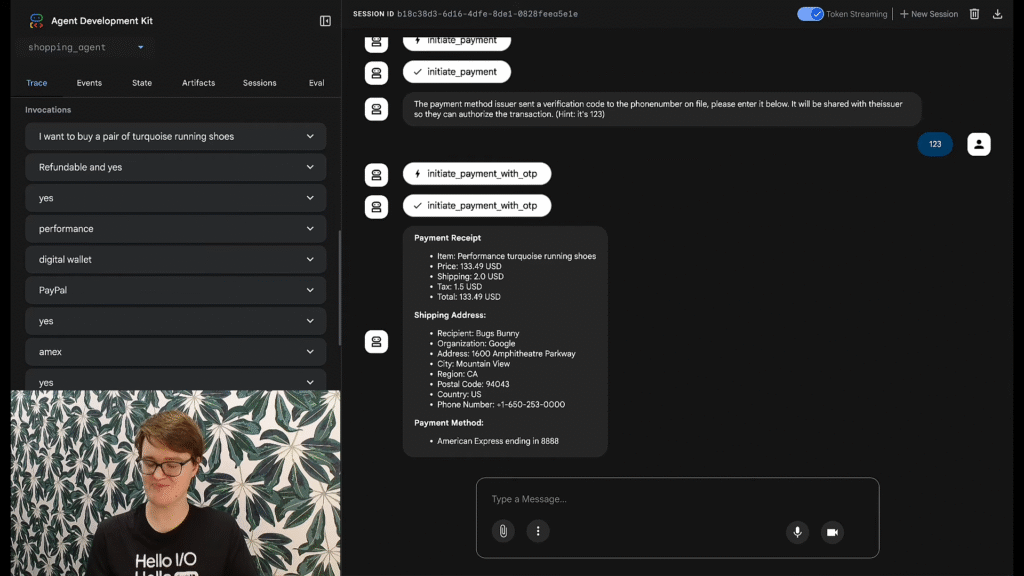
- Human Present Mandate: This is what we already have. Your AI finds a product, puts it in a cart, and then asks you for approval. You might use your face, fingerprint, or a password to say “Yes, buy it.” You are present for the transaction.
- Human Not Present Mandate (This is the big one): This is where you give your AI permission in advance. You set the rules. For example:
- Rule: “You are allowed to spend up to $50 per week on groceries.”
- Rule: “You are allowed to book any flight under $300 that I ask for.”
With this “intent mandate,” your AI agent can now complete the entire task for you, from start to finish, without bothering you for your card details every single time. It’s secure because you set the limits.
Why Include Crypto and “Stablecoins”?
This is one of the most interesting parts. The protocol supports regular credit cards, but it also has built-in support for stablecoins.
What’s a stablecoin? It’s a type of digital money (cryptocurrency) that is “pegged” or locked to a real-world currency. For example, one USDC (a popular stablecoin from the company Circle, another partner) is designed to always be worth exactly $1.
Including them is a big deal for a few reasons:
- Speed: Digital payments can happen instantly, 24/7, anywhere in the world, without waiting for bank business hours.
- Future-Proof: Many believe AI agents and digital money are two key parts of the next version of the internet (Web3). It makes sense to build them together.
- AI-to-AI Payments: This protocol isn’t just for an AI paying a human company. It could allow one AI to pay another AI for a service (e.g., your travel agent AI pays a data-analysis AI to find the best price). Crypto is perfect for these kinds of instant, automated micro-payments.
What Does This Mean for You Today?
Nothing, immediately.
You won’t be downloading an “AP2 app” tomorrow. This is not a product Google is selling. It’s an “open standard,” which means Google and its partners are publishing the rulebook for free so that developers and companies all over the world can use it to build new things.
Think of it as the foundational plumbing for a “new era of AI-driven commerce.”
The first people to use this will be developers at companies like Shopify, Etsy, or your bank. They will start building new features that use this protocol. In the future, you might see a “Pay with AI Agent” button or simply find that your Google Assistant is suddenly a lot more helpful at getting tasks done.