The world of Artificial Intelligence moves incredibly fast, and tech giant Alibaba just took a major leap forward. The company has released Qwen3-VL, a new family of AI models that are compact, powerful, and, according to initial tests, already outperforming similar models from major competitors.
This isn’t just another minor update; it represents a significant trend in AI: making powerful technology smaller and more accessible without sacrificing performance. Let’s break down what Qwen3-VL is and why it’s a big deal.
What Exactly is Qwen3-VL?
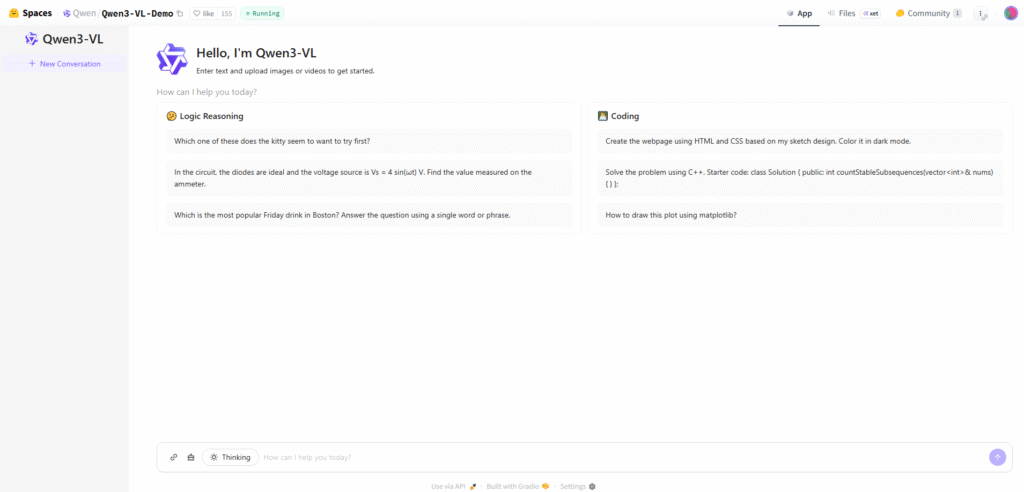
Think of Qwen3-VL as a new, smarter, and more efficient brain for computers. The “VL” stands for Vision-Language, which means this AI is “multimodal”—it can understand and process both text (language) and images (vision) at the same time. You could show it a chart and ask it a question about the data, and it would be able to both “see” the chart and “understand” your question.
The most exciting part is its size. Qwen3-VL comes in two main versions:
- Qwen3-VL-4B (4 billion parameters)
- Qwen3-VL-8B (8 billion parameters)
In AI, “parameters” are a bit like neurons in a brain. While bigger models with more parameters are often more powerful, they also require massive, expensive computer hardware to run. Alibaba’s achievement is packing incredible performance into these smaller, “compact” models.
This means they use less computer memory (VRAM), making them cheaper and easier for developers and businesses to use. They’ve retained the full capabilities of much larger models while being significantly more efficient.
How Good Is It? The Proof is in the Numbers
Alibaba isn’t just making empty claims. They’ve released benchmark charts comparing their new models against some of the best in the industry, and the results are impressive.
Despite their smaller size, the Qwen3-VL models outperform comparable models like Google’s Gemini 2.5 Flash Lite and OpenAI’s GPT-5 Nano in a wide range of tests. These tests cover areas like:
- Knowledge & Reasoning: Solving complex problems in science, technology, and math (STEM).
- Vision Understanding: Answering questions about images (VQA), understanding charts, and even recognizing text within documents.
- Instruction Following: Accurately following user commands and prompts.
- Agent Capabilities: Performing tasks and making decisions within a digital environment.
In many cases, these new compact models even rival the performance of Alibaba’s own flagship model from just six months ago (Qwen2.5-VL-72B), which is nearly ten times larger! This shows just how rapidly AI technology is improving.
Why Does This Matter to You?
You might not be an AI developer, but this development is important for several reasons:
- More Accessible AI: Smaller, efficient models mean powerful AI can run on less expensive hardware. This opens the door for more businesses, researchers, and creators to build innovative tools without needing a supercomputer.
- Smarter Apps on Your Devices: As models become more efficient, we get closer to having truly powerful AI run directly on our personal computers or even smartphones, making applications faster and more private.
- Increased Competition: When companies like Alibaba release strong, open-source models, it pushes the entire industry forward. This competition between tech giants leads to faster innovation, which ultimately benefits everyone.
For those interested in trying it out, Qwen3-VL is already being put to the test in public forums like the “Text and Vision Arena,” where users can compare different AI models head-to-head.
In conclusion, Alibaba’s Qwen3-VL is a powerful statement. It proves that the future of AI isn’t just about building the biggest model, but also about building the smartest and most efficient one.
Useful Links