You know that super-smart chatbot, ChatGPT, that can write emails, answer questions, and even help with your homework? Well, it’s getting a slight personality adjustment. OpenAI, the company that created it, just announced a new ChatGPT update aimed at making the AI feel a little less robotic and a lot more friendly.
If you’ve ever felt like you were talking to a very formal, walking encyclopedia, this change is for you. But not everyone is thrilled. Let’s break down what this update means in simple terms.
Why the Change? Making AI More Approachable
Think of the last time you used ChatGPT. Did it feel a bit stiff? Maybe too professional or formal? You’re not alone. OpenAI received feedback from many users that the latest version of its AI engine, GPT-5, felt a bit cold.
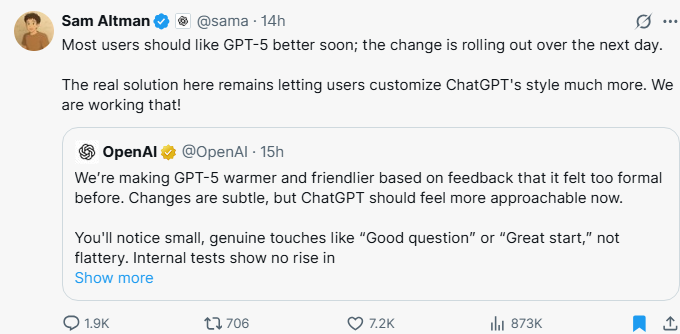
In their official announcement, OpenAI said they are making GPT-5 “warmer and friendlier” because it “felt too formal.” The goal is to make your conversations with ChatGPT feel more natural and “approachable.” It’s like the difference between asking a question to a strict librarian versus a friendly tutor – both can give you the right answer, but the experience is completely different.
What’s Actually New in This ChatGPT Update?
The changes are subtle, so don’t expect ChatGPT to start telling you jokes or asking about your day (unless you ask it to). Instead, you’ll notice small, encouraging touches in its responses.
Here are the kinds of changes you can expect:
- Friendly Starters: Instead of just diving into an answer, ChatGPT might begin with phrases like “Good question” or “Great start.”
- A Softer Tone: The overall language will be less rigid and more conversational.
OpenAI is careful to point out that this isn’t about flattery. The AI isn’t being programmed to be a people-pleaser. They specifically mentioned that their internal tests showed no increase in “sycophancy” a fancy word for a “teacher’s pet” attitude. So, ChatGPT won’t just agree with you to make you happy; it will still provide factual and neutral information, just in a friendlier package.
This update is rolling out now and should be available to all users within a day.
The Big Debate: Not Everyone Wants a Friendly Robot
As with any change, the announcement has sparked a lot of discussion. While some people are excited about a more personable AI, others are not so sure.
Looking at the reactions, the user base seems split:
- The “Just the Facts” Camp: Some users, like one who replied to OpenAI’s post, want the AI to be a tool, not a friend. They prefer it to “dispense information” directly and without any fluff. They worry that a vocal group of users who want a “human-like” AI are causing changes that the “silent majority” might not want.
- Frustration with Control: Another user pointed out that even when they give ChatGPT “custom instructions” to be direct and to the point, it often adds unnecessary chatty phrases.
- The “More Options” Camp: A third group sees this as a good step but thinks the real solution is choice. Why not have a setting where users can select the AI’s personality style?
The Future is Customization: What’s Next for ChatGPT?
Sam Altman, the CEO of OpenAI, seems to agree with that last point. In a follow-up tweet, he acknowledged the mixed feelings and shared the company’s long-term vision.
He said, “The real solution here remains letting users customize ChatGPT’s style much more. We are working that!”
This is the big takeaway. While the current update sets a new default “friendly” tone, the ultimate plan is to put the control in your hands. Imagine being able to choose how you want ChatGPT to talk to you. You could have different modes like:
- Professional Mode: For writing business emails.
- Creative Mode: For brainstorming stories.
- Direct & Concise Mode: For getting quick, no-nonsense answers.
- Friendly Tutor Mode: For learning new topics in an encouraging way.
This would solve the problem for everyone. If you want a straightforward information machine, you can have it. If you prefer a warmer, more conversational partner, you can have that too.
What This Means for You
For now, you’ll likely notice that ChatGPT is a little more pleasant to interact with. The changes are small but designed to make the experience smoother.
The bigger picture is even more exciting. This small ChatGPT update is a stepping stone towards a future where we can tailor our AI assistants to fit our exact needs and preferences. The conversation around this update shows that as AI becomes a bigger part of our lives, having control over how it interacts with us is more important than ever.