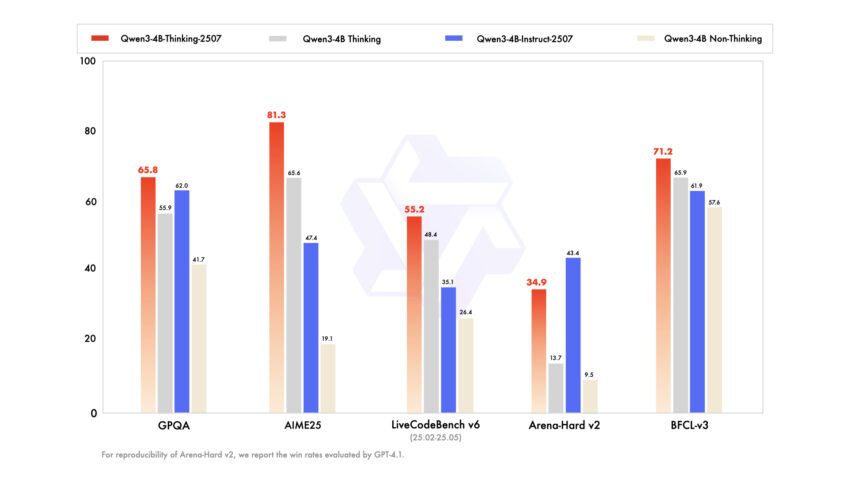
Meet the Twins: “Instruct” vs. “Thinking”
The Qwen team has released two specialized versions of their new 4 billion parameter model: Instruct and Thinking. While they share the same core brain, they have been trained for different purposes.
1. Qwen3-4B-Instruct: The Efficient Task-Master
The Instruct model is like a highly trained and obedient student who excels at following directions. You give it a clear command, and it delivers a direct, concise, and high-quality response.
What it’s best for:
- Direct Questions: “What is the capital of Australia?” -> “Canberra.”
- Simple Instructions: “Write a short, professional email to my boss asking for a day off.”
- Summarization: “Summarize this news article for me in three sentences.”
- Translation: “Translate ‘Hello, how are you?’ into French.”
The Instruct model is optimized for speed and accuracy on straightforward tasks. It’s your go-to assistant for getting things done efficiently.
2. Qwen3-4B-Thinking: The Deep Problem-Solver
This is where things get really interesting. The Thinking model is designed to tackle complex problems that require logic, reasoning, and multiple steps. Its superpower is a technique called Chain of Thought (CoT).
What is Chain of Thought?
Remember in school when your math teacher would say, “Show your work!”? You couldn’t just write down the answer; you had to show the step-by-step process you used to arrive at it. That’s exactly what the Thinking model does.
Instead of jumping straight to a conclusion, it breaks a problem down and “thinks” out loud, generating the logical steps it’s taking. This makes it incredibly powerful for tasks that would confuse other AI models.
What it’s best for:
- Math and Logic Puzzles: “If a bat and a ball cost $1.10 in total, and the bat costs $1.00 more than the ball, how much does the ball cost?” The AI will reason through the algebra step-by-step to arrive at the correct answer (5 cents).
- Complex Reasoning Questions: “If my meeting is at 3 PM, and it takes me 45 minutes to drive there, plus I need to stop for gas which takes 10 minutes, and I want to arrive 15 minutes early, what is the latest I can leave my house?”
- Planning and Strategy: “Create a simple 7-day workout plan for a beginner focused on cardio and core strength.”
By showing its thought process, the Thinking model is not only more likely to get the correct answer but also allows us to see how it got there. This transparency makes it more trustworthy and easier to correct if it makes a mistake in its reasoning.
Why is the “Thinking” Model a Big Deal?
The development of a “Thinking” AI that can effectively use Chain of Thought is a significant leap forward for several reasons:
- Improved Accuracy: For complex tasks, breaking the problem down drastically reduces the chance of errors.
- Greater Transparency: We can finally see the AI’s “reasoning.” This is crucial for building trust, especially when using AI for important decisions in fields like finance, medicine, or research.
- Enhanced Problem-Solving: It opens the door for AI to help with more sophisticated challenges, from debugging code and scientific research to strategic planning.
- Better Collaboration: When the AI explains its steps, it’s easier for a human user to collaborate with it, spot potential flaws, and guide it toward a better solution.
Conclusion: A Smarter and More Transparent AI Future
The release of the Qwen3-4B Instruct and Thinking models is more than just a technical update; it’s a glimpse into the future of human-AI interaction. While the Instruct model perfects the art of being a fast and reliable assistant, the Thinking model pioneers a new path where AI can tackle complex problems with logic and transparency.
For the average person, this means that the AI tools we use every day are becoming more capable and reliable. For developers and businesses, it unlocks new possibilities for creating smarter applications that can reason, plan, and solve problems in ways we’ve only just begun to imagine. The era of AI that not only knows but can also think is officially here.
Qwen Testing Model Links: 👇
Huggingface:
https://huggingface.co/Qwen/Qwen3-4B-Instruct-2507
https://huggingface.co/Qwen/Qwen3-4B-Thinking-2507
ModelScope:
https://modelscope.cn/models/Qwen/Qwen3-4B-Instruct-2507
https://modelscope.cn/models/Qwen/Qwen3-4B-Thinking-2507